

Building a barndominium can save you 20–30% compared to a traditional home, but securing financing requires navigating a different set of challenges. Unlike standard home mortgages, barndominium loans often involve unique credit requirements, construction specifics, and lender expectations. While the process may seem daunting, the right preparation can make your dream home a reality—and save you money along the way.
Start by exploring financing options that suit your situation. Traditional construction loans are a common choice, offering funds for both building and materials. If you’re a veteran, VA loans might provide an affordable path to ownership. Other possibilities include USDA loans for rural areas or personal loans for smaller-scale projects.
Understanding what lenders look for—such as detailed building plans, cost estimates, and your creditworthiness—is key to a smooth application process. With the right loan and a solid financial strategy, you’ll be well on your way to creating your dream barndominium without breaking the bank. Let’s dive into the financing paths that can help make it happen.
Contents
- 1 Understanding Barndominium Loan Types
- 2 Preparing Your Financial Documents
- 3 Credit Score Requirements
- 4 Construction Loan Application Process
- 5 Down Payment Options Available
- 6 Self Build Financing Strategies
- 7 Land and Construction Package Deals
- 8 Interest Rates and Payment Terms
- 9 Frequently Asked Questions
- 9.1 Can I Convert an Existing Barn Into a Barndominium Using Construction Loans?
- 9.2 What Happens if Construction Costs Exceed the Approved Loan Amount?
- 9.3 Are Barndominium Loans Typically Harder to Get Approved Than Traditional Mortgages?
- 9.4 Can I Rent Out My Barndominium While Still Paying off Construction Loans?
- 9.5 Do Insurance Companies Treat Barndominiums Differently for Loan Requirement Purposes?
Understanding Barndominium Loan Types
The world of barndominium financing offers several viable paths to fund your dream home.
When conducting your barndominium loan comparison, you’ll find options ranging from conventional mortgages to specialized construction loans. Each type has distinct financing eligibility criteria you’ll need to navigate.
Conventional mortgages work similarly to traditional home loans but require your barndominium to meet specific residential-use standards.
Construction loans, often preferred for custom builds, provide staged funding throughout the building process.
If you’re a veteran, VA loans offer attractive terms with no down payment requirements, while FHA and USDA loans present additional government-backed options for qualified borrowers.
Local banks and credit unions frequently offer portfolio loans with more flexible terms, particularly beneficial if your project doesn’t fit conventional lending parameters.
Preparing Your Financial Documents

Successful barndominium financing begins with three critical steps: gathering, organizing, and verifying your financial documents. You’ll need to demonstrate your financial stability through careful financial document organization, including tax returns, bank statements, and detailed income verification tips.
| Essential Documents | Purpose |
|---|---|
| Tax Returns & W-2s | Prove income history and stability |
| Bank Statements | Show cash flow and savings |
| Construction Plans | Detail project costs and timeline |
Start by creating a thorough file of your financial records, ensuring everything’s current and accurate. Your documentation should include property inspection reports, building permits, and detailed construction estimates. Remember, transparent and well-organized documentation can greatly streamline your loan approval process and potentially secure better terms. Keep digital copies of everything and maintain a checklist to track what you’ve gathered.
Credit Score Requirements

Building your dream barndominium starts with understanding credit score requirements, as most lenders expect a minimum score of 640 for approval.
For the best interest rates and terms, you’ll want to aim for 720 or higher, which helps offset the unique lending challenges of barndominium construction.
To improve your chances of loan approval, focus on credit score improvement strategies.
Keep your credit utilization below 30%, make all payments early, and avoid applying for new credit before seeking your construction loan.
You can also become an authorized user on a responsible person’s credit account to boost your score.
Construction Loan Application Process

Steering through the construction loan application process requires careful attention to several key steps.
You’ll need to understand loan eligibility criteria and develop effective lender communication strategies before submitting your application. Start by gathering thorough documentation, including financial records, construction plans, and builder bids.
Three essential phases of the application process include:
- Obtaining preapproval from multiple lenders to compare rates and terms
- Submitting a complete application package with detailed construction plans and cost estimates
- Working through the underwriting process while maintaining clear communication with your chosen lender
Remember to select a lender who’s familiar with barndominium construction and be prepared for a phased funding approach.
You’ll need to maintain flexibility throughout the process while staying committed to your approved construction timeline and building specifications.
Down Payment Options Available

A solid down payment strategy forms the foundation of your barndominium financing journey.
When comparing loan options, you’ll find conventional loans typically require 5-20% down, while government-backed programs offer more flexible alternatives. FHA loans need just 3.5% down with good credit, and VA loans may require no down payment for eligible veterans.
If you’re considering specialized barndominium financing, prepare for potentially higher down payments of 25-40%.
However, don’t overlook down payment assistance programs that could help reduce your upfront costs through grants or low-interest loans.
Smart loan comparison involves weighing these options against your financial situation. Traditional lenders, government programs, and specialized financing each offer distinct down payment structures, so you’ll want to evaluate which aligns best with your resources and long-term goals.
Self Build Financing Strategies

When you’re taking on a self-build barndominium project, you’ll need to carefully evaluate your financing options, including construction loans that allow owner-builders and specialized programs for DIY projects.
Your choice between personal loans, construction loans, or home equity options will depend heavily on your documented construction experience, detailed cost breakdowns, and proof that you can complete key building phases yourself.
You’ll typically face stricter lending requirements when building without a general contractor, so be prepared to show thorough plans, skills certifications, and a clear timeline for completing each phase of construction.
Loan Options When Self-Building
Self-building a barndominium opens up four key financing pathways that can help turn your dream home into reality.
Traditional mortgages, construction loans, specialized lenders, and alternative financing each offer distinct advantages for your project. When exploring barndominium financing options, you’ll want to evaluate which path aligns with your self-build budgeting tips and financial situation.
Consider these essential factors when selecting your loan type:
- Construction loans offer staged funding but come with higher interest rates.
- Traditional mortgages typically require 20% down but may have better long-term rates.
- Specialized lenders understand barndominiums better and might offer more flexible terms.
If you’re building in a rural area, don’t overlook USDA loans, which can provide favorable terms and lower down payments.
Local credit unions often show more openness to financing unconventional homes, potentially making them valuable partners in your project.
DIY Project Cost Analysis
Every successful DIY barndominium project starts with a thorough cost analysis that’ll help you secure appropriate financing and stay within budget. You’ll need to consider the cost of barndominium construction, as well as any additional expenses such as land acquisition, permits, and materials. It’s important to research and gather quotes from multiple contractors to ensure you’re getting the most competitive pricing for your project. By carefully evaluating the cost of barndominium construction, you can make informed decisions and avoid any surprises that could derail your budget. When planning your barndominium project, it’s also essential to factor in potential overages and unexpected expenses. Setting aside a contingency fund of at least 10% of your total budget can provide peace of mind and ensure you’re prepared for any unforeseen costs. Additionally, tracking your expenses and staying organized throughout the construction process can help you stick to your budget. These essential budget tips will help you stay on track and achieve your dream barndominium without breaking the bank. Once you have a clear understanding of the overall cost of your barndominium project, you can then begin to plan for other aspects of your dream home budget planning. This includes allocating funds for interior design, landscaping, and any additional customization or upgrades you may want to include. By taking a comprehensive approach to budget planning, you can ensure that your DIY barndominium project is a success from start to finish.
When planning your build, you’ll need to account for materials ($25,400-$100,700), specialized labor ($85-$95 per square foot), and interior finishing ($40-$100 per square foot).
Smart budget considerations include material sourcing strategies that can help you save considerably.
Consider starting with a kit ($20,000-$90,000+) rather than building from scratch, but remember to factor in assembly costs.
You’ll want to set aside 10-20% of your total budget as a contingency fund for unexpected expenses.
The average total cost ranges from $112,800 to $504,000, but you can potentially reduce this through careful planning and strategic DIY work on suitable aspects of the project.
Contractor-Free Financing Requirements
Securing financing for a contractor-free barndominium build requires a strategic approach and thorough documentation. When addressing contractor concerns, you’ll need to prove your competency to handle the project independently.
Many traditional lenders prefer working with licensed contractors, but financing alternatives exist for determined self-builders.
To strengthen your loan application for a DIY build, focus on these critical elements:
- Develop detailed construction plans with precise timelines and cost breakdowns.
- Document your relevant building experience or completed construction courses.
- Create an extensive materials list with verified supplier quotes.
You can explore options like Farm Credit loans, personal financing, or hard money lenders who understand self-build projects.
Remember to maintain excellent credit scores and gather all necessary permits before approaching lenders. Your thorough preparation will demonstrate project viability despite the absence of a contractor.
Land and Construction Package Deals
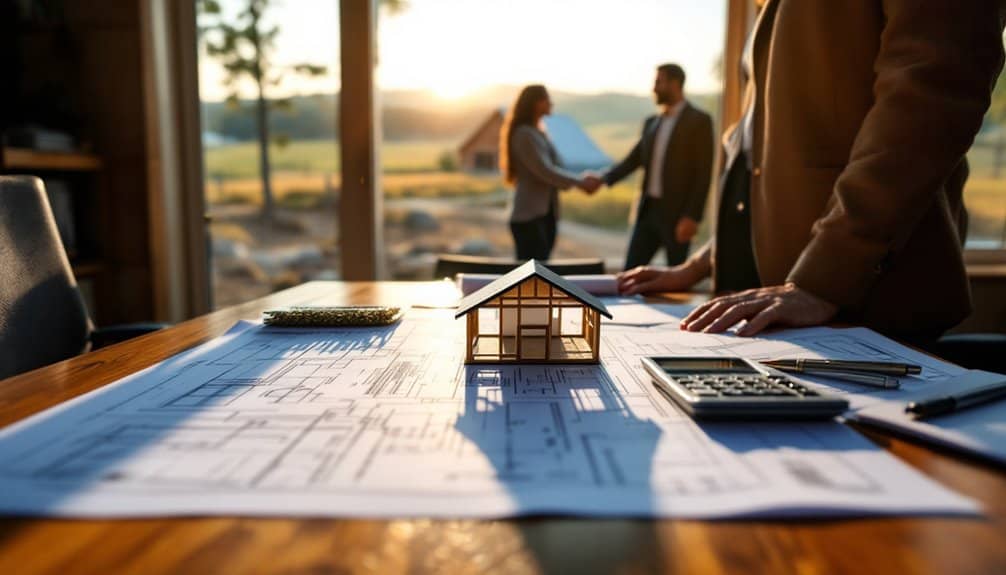
Many prospective barndominium owners can simplify their building journey by opting for land and construction package deals. These all-encompassing financing packages can streamline both land acquisition and building processes, offering you a more straightforward path to ownership.
When you’re exploring these options, you’ll find that lenders often prefer package deals because they can better assess the total project value.
You’ll need to guarantee your chosen package aligns with local zoning regulations and building codes while meeting utility requirements. Look for deals that include property inspection, terrain evaluation, and necessary permits.
Most construction timelines span up to a year, so you’ll want a package that accommodates this timeline through proper loan structuring. Remember to verify that your package includes detailed plans and construction schedules, as these are vital for loan approval.
Interest Rates and Payment Terms

When exploring barndominium financing options, you’ll need to weigh the benefits of fixed-rate loans, which offer predictable monthly payments, against variable-rate loans that might start lower but carry more risk.
Your monthly payments will depend on factors like your loan amount, interest rate, loan term, and whether you’ve opted for a construction-to-permanent loan that converts to a traditional mortgage.
You can use online calculators to estimate payments, but it’s smart to add 15-20% to these calculations to account for insurance, taxes, and potential rate fluctuations if you choose a variable rate.
Fixed Vs Variable Rates
Two fundamental choices face barndominium buyers when selecting their mortgage: fixed or variable interest rates.
Fixed rate benefits include predictable payments and protection against market fluctuations, while variable rate risks can expose you to potentially higher costs over time.
When choosing between these options for your barndominium, consider these vital factors:
- Market timing – With rates projected to drop in 2024, securing a fixed rate below 6% could provide long-term savings.
- Construction phases – Fixed rates can simplify the shift from construction loans to permanent mortgages.
- Budget stability – Your financial planning needs may favor the consistency of fixed payments over variable rates’ unpredictability.
For most barndominium projects, a fixed-rate mortgage offers the stability and predictability that’s particularly valuable during the construction-to-permanent loan shift process.
Monthly Payment Calculations
Understanding your monthly payment calculations is essential before committing to a barndominium loan. Your down payment percentage notably impacts your monthly costs – a 20% down payment eliminates PMI requirements and reduces your loan amount substantially.
For effective budget planning, consider how loan terms affect your payments; while 30-year terms offer lower monthly amounts, you’ll pay more interest over time.
When developing your monthly payment strategies, factor in your interest rate, which varies based on your credit score and loan type. For a $400,000 barndominium, a 20% down payment ($80,000) reduces your loan to $320,000.
Don’t forget to account for additional costs like mortgage insurance, origination fees, and annual fees, especially with FHA or USDA loans, as these will impact your total monthly obligation.
Frequently Asked Questions
Can I Convert an Existing Barn Into a Barndominium Using Construction Loans?
Yes, you can use construction loans for your barn conversion project. You’ll need detailed plans, an approved builder, and to meet lender requirements, but it’s a viable financing option for transforming your barn.
What Happens if Construction Costs Exceed the Approved Loan Amount?
You’ll need to act fast, smart, and decisive when budget overruns occur. You can tap into additional financing options, use personal savings, negotiate with contractors, or restructure your loan terms with your lender.
Are Barndominium Loans Typically Harder to Get Approved Than Traditional Mortgages?
Yes, you’ll find barndominium financing more challenging than traditional mortgages due to their unique nature. Your loan eligibility often faces stricter requirements, and you’ll need to work with specialized lenders who understand these properties.
Can I Rent Out My Barndominium While Still Paying off Construction Loans?
You typically can’t generate rental income during construction loan periods. It’s best to check your specific loan terms, as most lenders prohibit renting while under construction and require the property as your primary residence.
Do Insurance Companies Treat Barndominiums Differently for Loan Requirement Purposes?
You’ll find insurance companies often treat barndominiums uniquely, requiring specialized insurance coverage and detailed property appraisals due to their hybrid nature. They’ll typically need both residential and commercial policy elements to satisfy loan requirements.
Conclusion
Building your dream barndominium doesn’t have to drain your bank account – ironically, the more financial preparation you do upfront, the less stressful your construction journey will be. You’ll want to weigh all loan options, maintain pristine credit, and assemble your documentation meticulously. While it might seem overwhelming now, you’re setting yourself up for success by understanding these financing fundamentals before breaking ground on your modern rustic paradise. When it comes to barndominium construction tips, it’s important to also consider alternative financing methods such as personal loans or using equity from existing property. Additionally, seeking out reputable barndominium builders who have experience in working with your preferred loan options can also help make the construction process smoother. By following these financing and construction tips, you can turn your dream barndominium into a reality without breaking the bank.